In Electric Dress, Joanne Diaz jolts through history like a current, bringing with her the ideas of art, nature, stasis, and progress, considering what’s beautiful and what’s grotesque. Drawing from archival material and visual art objects, Diaz grapples with the personal and the geographical, insisting on the ways we are tied to our pasts and to our landscapes. Electric Dress is a powerful critique of technology, movement, and aesthetics, negotiating together what we inherit and what we wish to disavow.
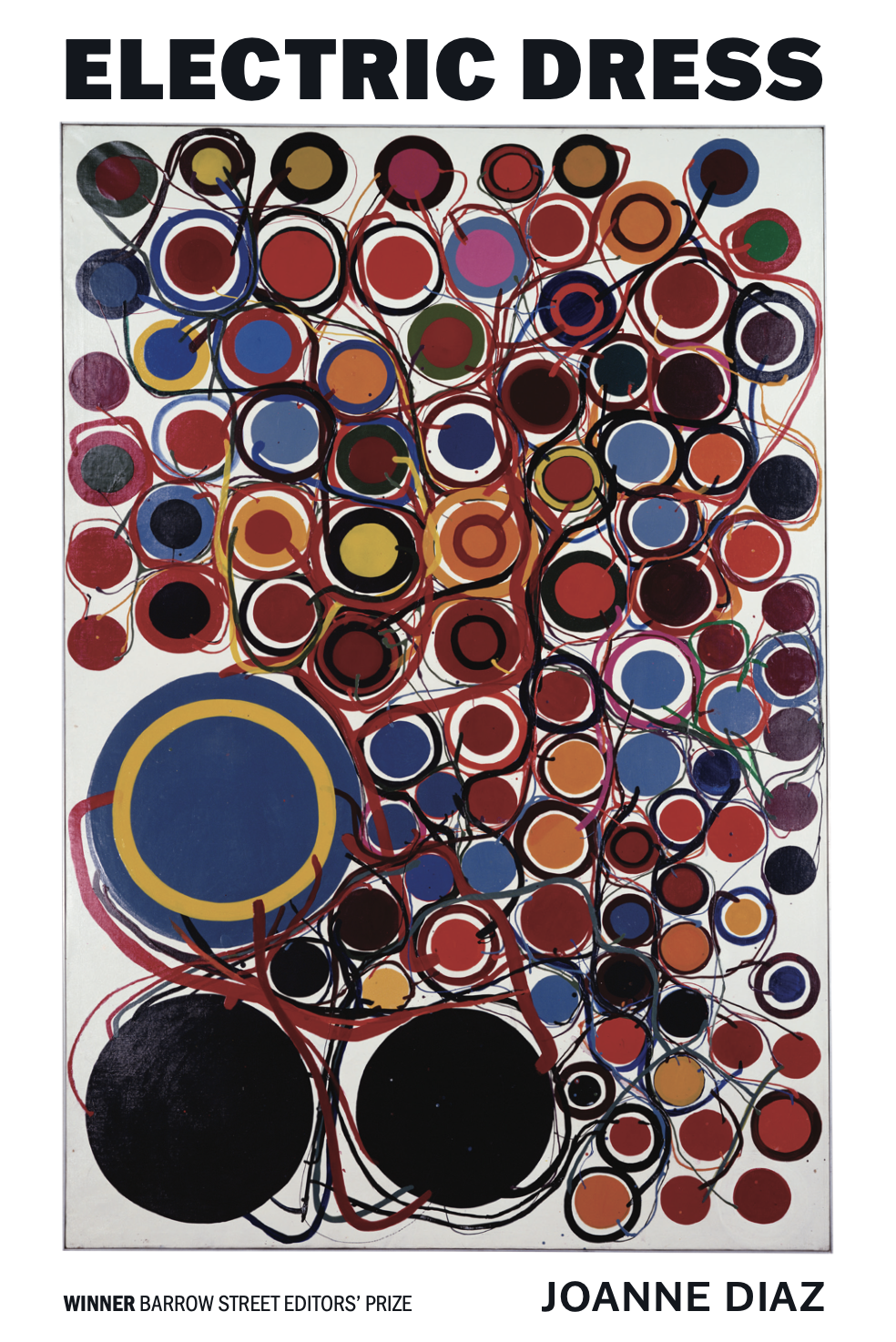
Electric Dress, Joanne Diaz
$18.00
Winner of the Barrow Street Editors’ Prize
ISBN: 978-1-962131-12-4
Binding: Paperback
Published: April 15th, 2026
Joanne Diaz deftly weaves through art and history, science and etymology, to reveal all the miracles and terrors of our own making. These poems move in delightful and surprising ways through fears and violences, but they only pause there as they travel towards common and impossible tenderness.
— TRACI BRIMHALL
Joanne Diaz’s poems move with a quiet force as they explore dark forms of knowledge; they are sensuous and learned, erudite and erotically alive. Electric Dress, her exhilarating new book, is magnificently charged with sparks of ingenuity and awe.
— RICHIE HOFMANN
Just when we need it most, Electric Dress delivers a multifaceted poetry of social justice via an intertextual weaving of history, biography, science (Edison’s and Bell’s inventions, medicine, ecology, astronomy), classical mythology, literature, and visual art. In fact, it is largely an ekphrastic collection, but only in the richest and most resonant ways—poems that re-see and reinterpret the art, that connect it to larger concerns, and that give astute attention to the artists’ processes, historical and cultural contexts, and lives. What moves me most about this insightful collection is the depth of empathy Diaz has for her subjects—artists and writers who faced fascist regimes, the ravages of war, and other hardships; laborers (“ghost workers”) who often lose their lives on the job; children who have accidentally shot another; an angry elephant named Topsy who was executed by electrocution: “In the moments before Topsy died,/it almost seemed like the cyanide-laced carrots/and her slow walk in copper slippers/were a part of the elephant’s wish/a last great bow/that only she could initiate.” Tell me, how does such a poem ever leave you? I’ll tell you, it doesn’t.
— BRENDA CÁRDENAS
Invocation to Electricity
You who are free
from the burdens
of animal, vegetable,
and mineral states,
you who are perverse
in your transit
through all three:
what use is it
to speak your name? You
are ubiquitous and constant,
more faithful
than any human, you
who bound my parents
in a helix of wires
and sound and light,
two ordinary people
charged to maintain
your circuits all their lives.
Today, at the supermarket,
I saw you in the bolts
of lightning that rose
along the arms
of a man’s sweatshirt.
When he turned
I saw the letters—I.B.E.W.—
sprayed across his chest,
and the fuse that connects
all workers—thousands,
for decades—the electricians,
the telephone operators,
the welders,
the lighting technicians,
wizards whose wires
weave through me.
In this state, I see
every piece of amber vibrate,
a vestige of when you
were mere spirit
or twitch, pure radiance
beyond the harness
of any human.
Always your eros stirs
the universe; you
are a catalog of the crimes
done in your name,
some of which
are archived in a trail
of inert paper,
bleached by the machines
that feed from you.
You thrive in every melody
we transmit,
in familiar voices
that shuttles across
the nation, in every flash
of light that glows
until each wire
is the dust that speckles
our galaxy, and only you
can truly reanimate the dead.
Joanne Diaz is the author of The Lessons (winner of the Gerald Cable First Book Award from Silverfish Review Press) and My Favorite Tyrants (winner of the Brittingham Award from the University of Wisconsin Press). With Ian Morris, she is the co-editor of The Little Magazine in Contemporary America (University of Chicago Press), and she is the co-host, with Abram Van Engen, of the Poetry for All podcast. She is the recipient of fellowships from the Illinois Arts Council and the National Endowment for the Arts, and she has also received fellowships from Ragdale and the Virginia Center for Creative Arts. She is the Isaac Funk Professor of English at Illinois Wesleyan University.